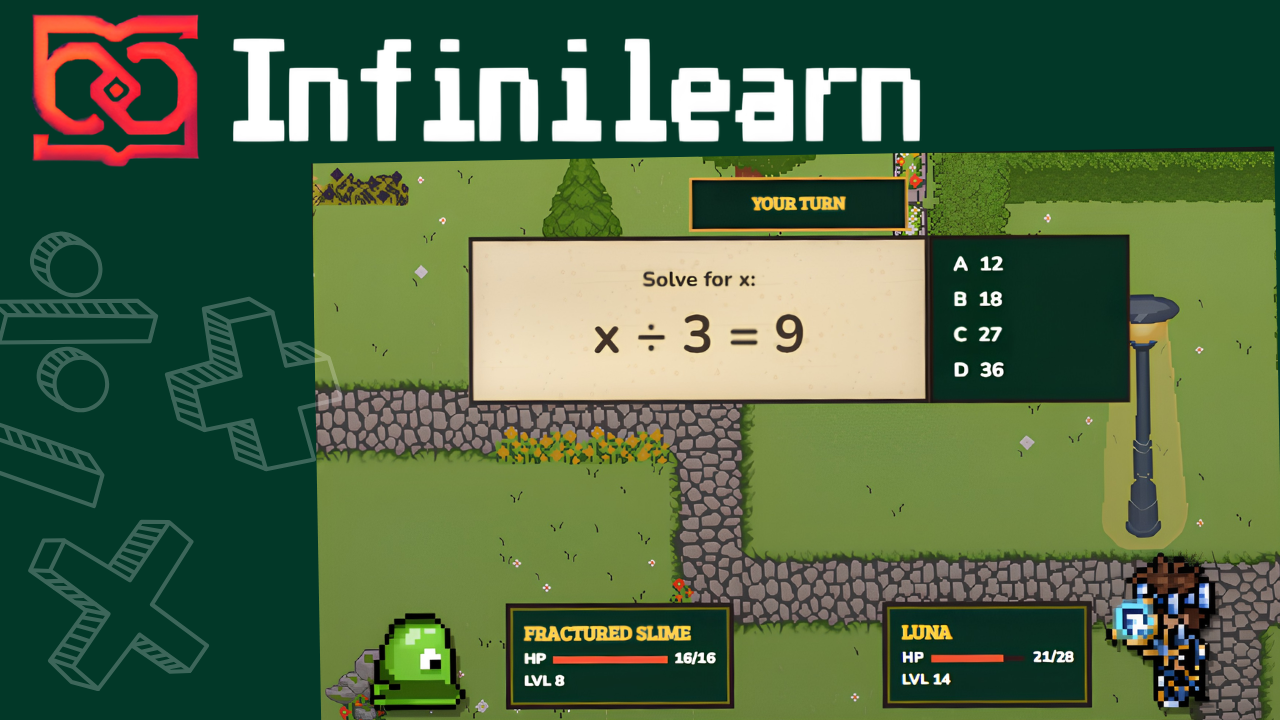
Infinilearn is a free 2D multiplayer math RPG for 4th to 9th graders, built with Phaser, React, and TypeScript on Firebase by founder Adrian Martinez. Kids explore a top-down world, take on quests and fight monsters, and every battle is a math problem. There is co-op and PvP too, and the Infinilearn site reports more than 50,000 signups and over 3,300 teachers.
Math is how players attack, craft, unlock areas, and move the story forward, so there is no worksheet hiding behind the adventure. The student game is free, with no ads, no in-game purchases, and no open chat: multiplayer communication uses preset quick-chat lines. It runs in the browser with no downloads, including on school Chromebooks, and teachers get a free classroom dashboard with accuracy by math topic.
We spoke with Adrian, now a freshman at UC Berkeley, about how a childhood spent building Minecraft servers led to a classroom math RPG, how Phaser and React share the work, and why a $20 Chromebook decides what ships.
From Minecraft Servers to a Multiplayer Math RPG Used in Classrooms
Q: You built Minecraft server mods that reached a million views when you were 11, and now, as a freshman at UC Berkeley, you have a multiplayer math RPG running in thousands of classrooms. How did that journey lead you to Infinilearn?
I think games are an integral part of almost every founder's childhood. For me, it was Minecraft. I wasn't just playing; I was building servers, resource packs, skins, writing mods, and watching what made people stay. That's basically product work; I just didn't know the word for it yet. Infinilearn pivoted four times before landing here, but the throughline was always the same: I understood how games hold attention, and I wanted to point that at something that mattered. Math was the obvious target because it's the subject kids decide they're "bad at" earliest.
Q: Infinilearn now has nearly 40,000 students playing it, is trusted by more than 3,100 teachers, and has had over 2 million math problems solved on the platform. Did you expect it to grow like this?
No. When we relaunched, my end-of-year goal was 20,000 users. I beat that with four months to go, and we actually just crossed 50k. I remember being nervous about hitting 20k. It's a strange feeling to watch a number you thought was ambitious become the floor.
Q: How did you get Infinilearn in front of teachers and students? What worked for you in terms of reaching people?
In person. I'd show up to schools at 7am, walk up to the front desk, and ask if I could pitch to teachers before first period. Most said no. Some said yes. The teachers who said yes told other teachers, and their students went home and told their parents. Nothing online came close to that early on. Distribution for a K-12 product is a lot of awkward waiting/standing in hallways.
"Infinilearn should feel like it was made by people who actually love games, not by a worksheet company wearing a fantasy hat."
Designing a Math RPG Where Every Battle Is a Math Problem
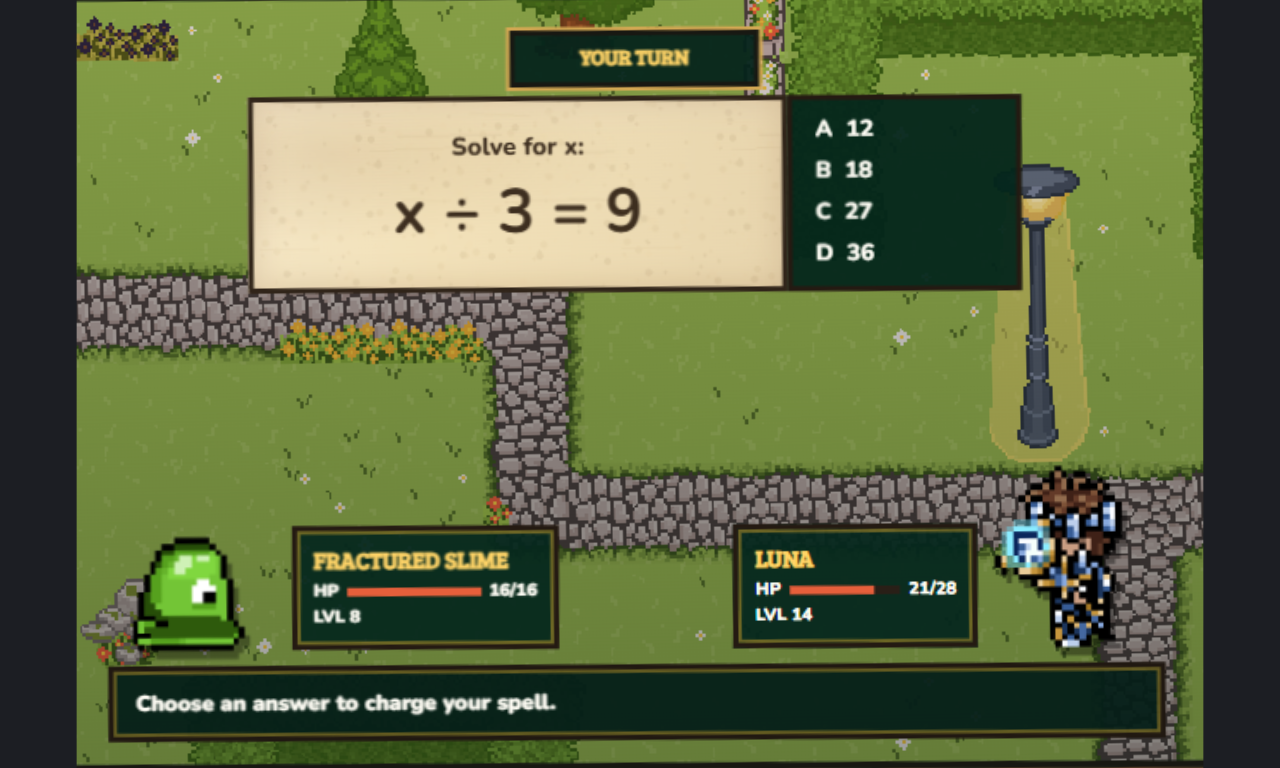
Q: Every battle is a math problem. How did you design that so it feels like a real RPG mechanic rather than a lesson dressed up as a game?
The core concept is math = power. Every stat, every ability, every piece of visible progression is only earned by actually getting better at math. You can't grind your way around it. If you want to hit harder, you master the next concept. That's what keeps it from feeling like a worksheet with a sprite on top: the math isn't a gate in front of the game; it IS the game.
"The math isn't a gate in front of the game; it IS the game."
Phaser, React and TypeScript: Building a Multiplayer Classroom Game
Q: You used Phaser alongside React, TypeScript and Firebase. How does Phaser fit into that stack, and why did you choose it for the game side?
React handles everything around the game: dashboards, parent analytics, teacher views, onboarding. Phaser handles the world itself. The reason I picked Phaser is flexibility. It doesn't force an architecture on you, so we could build a top-down multiplayer RPG with a math engine inside it and shape the loop exactly how we wanted, with the flexibility for iOS/Android native apps in the future. TypeScript across both sides means the game and the app share types, and Google Cloud sits underneath as the backend for all of it.
"The reason I picked Phaser is flexibility. It doesn't force an architecture on you, so we could build a top-down multiplayer RPG with a math engine inside it and shape the loop exactly how we wanted [...]."
Q: Running a multiplayer top-down world in Phaser for tens of thousands of students is no small feat. How did you approach that?
Honestly, not elegantly. Our servers are the weakest part of the system right now and I'll say that openly. We prioritized getting a real game into real classrooms over building the perfect backend, and that tradeoff was correct, but we're paying for it now. Too much usage is a pretty good problem to have, though haha.
Q: How do you keep the game performant for students on school devices and slower connections?
I bought a $20 old Chromebook off eBay and it's my benchmark. If the full game isn't playable on that machine, it doesn't ship. Most of our students are on devices like that, on school wifi that's shared with 800 other kids. Testing on a fancy $5k MacBook tells you nothing.
"I bought a $20 old Chromebook off eBay and it's my benchmark. If the full game isn't playable on that machine, it doesn't ship."
Q: What has been the hardest technical problem to solve so far?
Keeping the multiplayer world and the math state in sync without the game feeling laggy. A battle is a math problem, so the answer has to be validated, the stats have to update, and every other player in the area has to see the result, all on a school connection. Getting that to feel instant on the Chromebook was harder than anything on the rendering side.
Q: What other tools or libraries have been essential alongside Phaser?
Google Cloud primarily, Vercel for deploys. But the thing we're most proud of isn't a library. All of our in-game art is made by real artists, not AI. That was a deliberate choice. Kids can tell, and teachers can tell.
Founder Life at UC Berkeley and the Road to a Million Players
Q: You are a freshman at UC Berkeley. What does your day-to-day look like juggling Infinilearn with classes and everything else?
Genuinely tough. I started taking dual enrollment classes in 8th grade, so a lot of credits transferred and I get to graduate early on a reduced course load. That's the only reason it works. Outside of school and Infinilearn I don't do much right now. I had to quit playing ice hockey, which I still miss. I keep piano and chess around because they're the only things that fully switch my brain off.
Q: What is next for Infinilearn?
A million users. That's the number. Everything we're building right now is in service of getting there without the game breaking.
"The goal is simple: make math feel like something worth entering, not something to survive."
The full student game is free. Premium ($9.99 a month or $59.99 a year) is optional and adds deeper parent insight and cosmetic extras, not locked math content. Teachers can create classes, add students, and use the classroom dashboard at no cost.
Play Infinilearn
Free to play in your browser. Teachers can set up a class and share a join code at no cost.