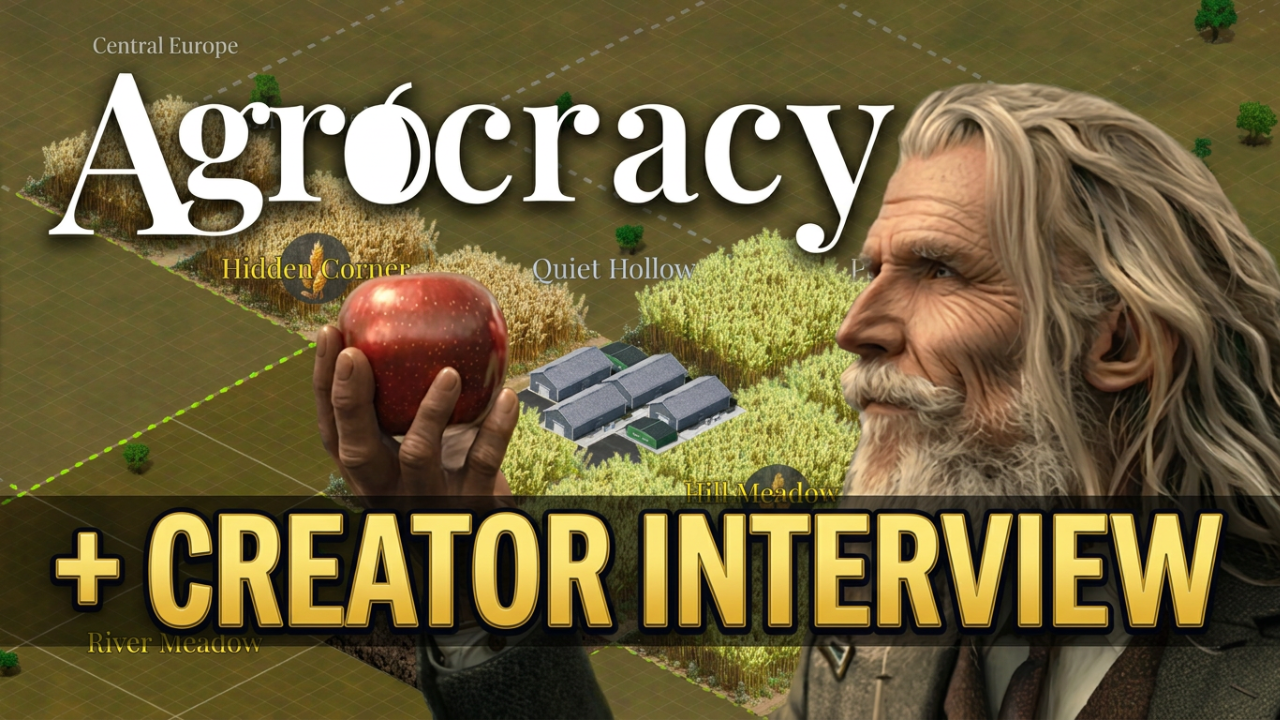
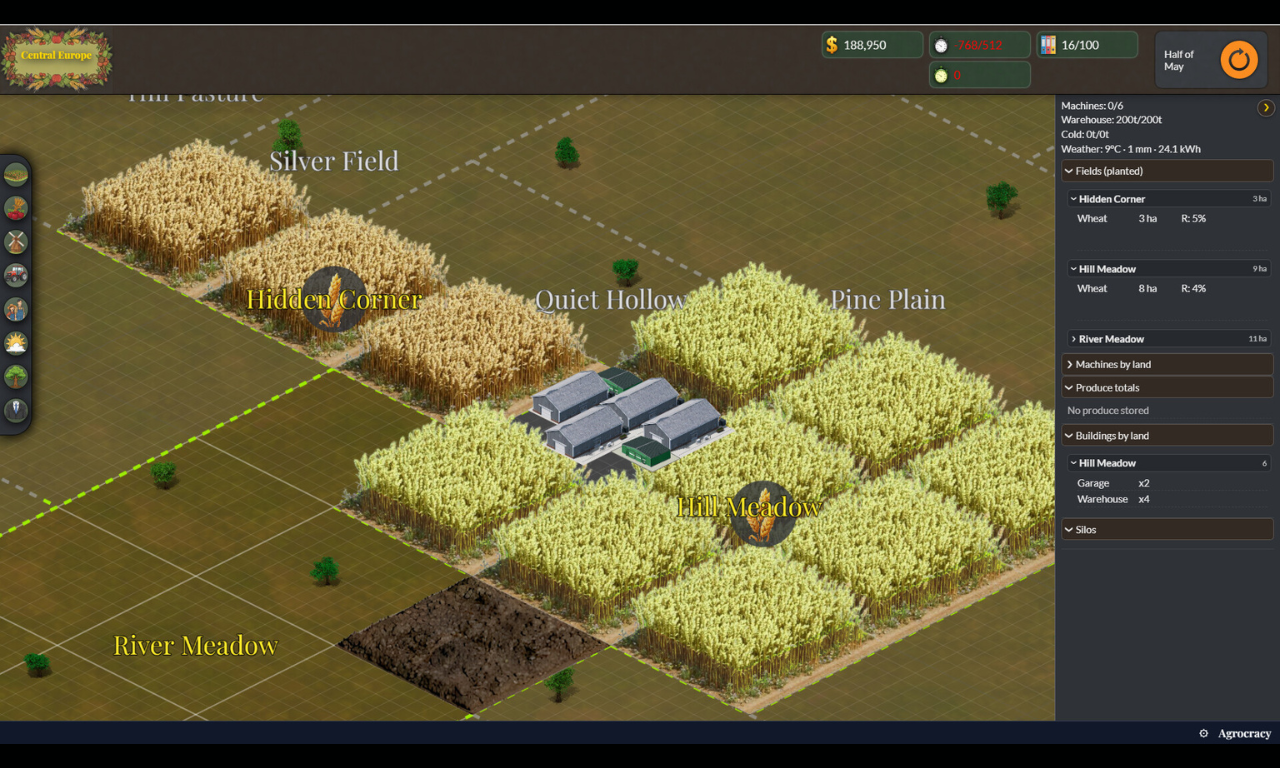
Most farming games hand you a watering can, a dog, and a sunny afternoon. Agrocracy hands you a balance sheet, a weather forecast, and a 30km² isometric map. The goal isn't to find peace in the soil. It's about building a profitable agricultural enterprise without going bankrupt first.
Built by Filip Wróbel, the solo developer behind Pluvio Studio, Agrocracy is a Phaser farming game unlike anything else in the genre. It's turn-based, hardcore, and inspired by classic tycoons like Railroad Tycoon and SimCity. "Creating a cozy game would simply not be my cup of tea," Filip explains. "And I also feel like non-cozy games might be undersaturated."
How Phaser Powers the Isometric Map and Shaders
Agrocracy runs on a combination of Phaser, Angular, and Java, each handling a distinct layer of the game. Phaser owns the map: all the isometric rendering, the shaders, the visual layer. Angular handles the UI. Java runs the simulation underneath. "The data flow is very typical for any web application," Filip notes, "and could be used with or without Phaser."
"The map is made entirely in Phaser, and all the isometric stuff is Phaser too. Shaders are made with Phaser as well."
It's an architecture that reflects the scope of the project. Managing crops, workers, machines, weather and finances across 30km² isn't a small problem, and splitting responsibilities across technologies keeps each layer clean and maintainable.
Building a Turn-Based Farming Game Loop: How Agrocracy Handles Complexity
One of the trickiest design challenges in a game like this is making many systems (weather, crop growth, labor, economics) feel connected without creating spaghetti code. The solution here is elegant: everything resolves at the turn boundary. Players gather information, make decisions, then hit "new turn." Only then does the simulation kick in.
"So while they are interdependent, they are treated as independent. The game itself changes things only during the turn transition."
That separation makes the system predictable for both the player and the codebase. Actions queue up, the turn resolves, consequences land. Repeat.
Realistic Weather in a Farming Game Without Physics Simulation
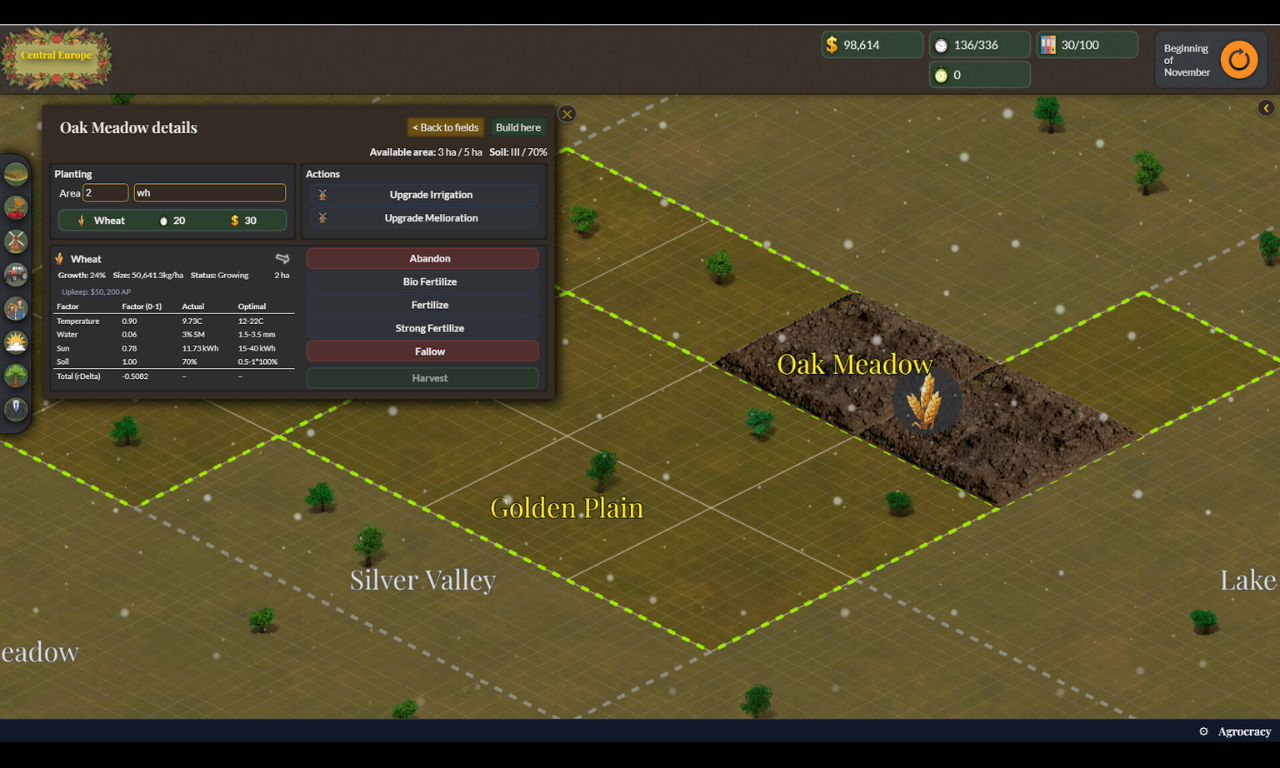
Weather is the central force in Agrocracy: it determines what you can grow, when you can harvest, and when your plans fall apart. Implementing it realistically without simulating atmospheric physics required a smart shortcut: two-week turns.
"I don't need to rely on weather physics or interfering phenomena," the dev explains. "I can simply use statistical data for the given climate. If my turn length were different, I couldn't do it this way and would probably end up with real weather modelling." The result is a system that feels realistic to the player while staying computationally light and designer-friendly.
Using AI Tools to Build a Solo Indie Game: Midjourney, Gemini and GIMP
All audio, effects and music were made by Filip himself.
For visuals, Midjourney and Gemini provided a starting point, with extensive manual cleanup in GIMP. "Generated isometric assets are almost never ready to use as they are," he says. "They often have alignment issues, wrong shadows, inconsistent backgrounds. They still need to be curated, cleaned up, and sometimes heavily modified."
Why This Solo Dev Is Building All His Future Games with Phaser
Like any tool, Phaser has its constraints, but for Filip, the fit is clearly right. Agrocracy is currently in the playtest phase on Steam, and Filip is already clear on what comes next, at least on the technical side.
"I plan to develop all my future games with Phaser. It perfectly fits my needs, and while I notice some limitations, I try to build with respect to them or bypass them with other things."
This is also Pluvio Studio's first official commercial release, and Filip is taking a measured approach to what comes next. "This is my first official commercial release, so it's really like testing the ground for me. Right now, I have some insight into this game and the whole process, but I think I need to postpone any conclusions until the release date."
How Do You Know When a Game Like This Is Done?
It's a question every ambitious solo dev has to wrestle with. For Filip, the answer is honest: it never really is. "It's simply never done. There are always things that could be added or improved." What helped was a conscious decision to limit scope. "I had to fight myself because I had a million ideas. Eventually, my scope became defined and limited, with some room for extension."
The visual approach also helped. Isometric graphics with a pre-rendered 3D look aren't exactly cutting edge in 2026, but Filip sees that as a feature, not a flaw. "My visual design choices make this game hard to age badly. Isometric graphics that look like pre-rendered 3D are not really up to date nowadays, but they have aged with dignity."